Benchmarking the Limits of Long-Context Spoken Language Models
The first benchmark for long-context understanding in spoken language models
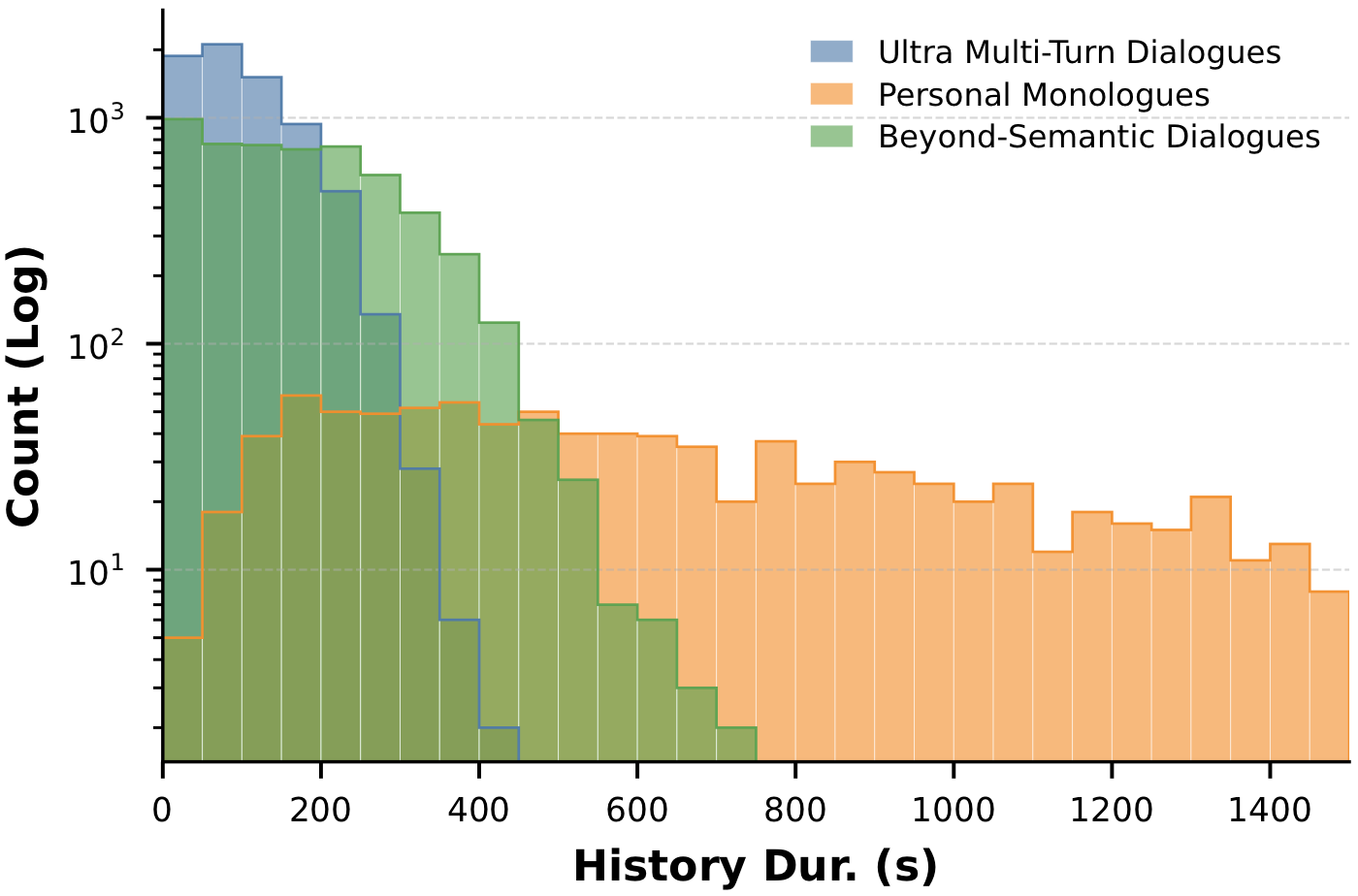
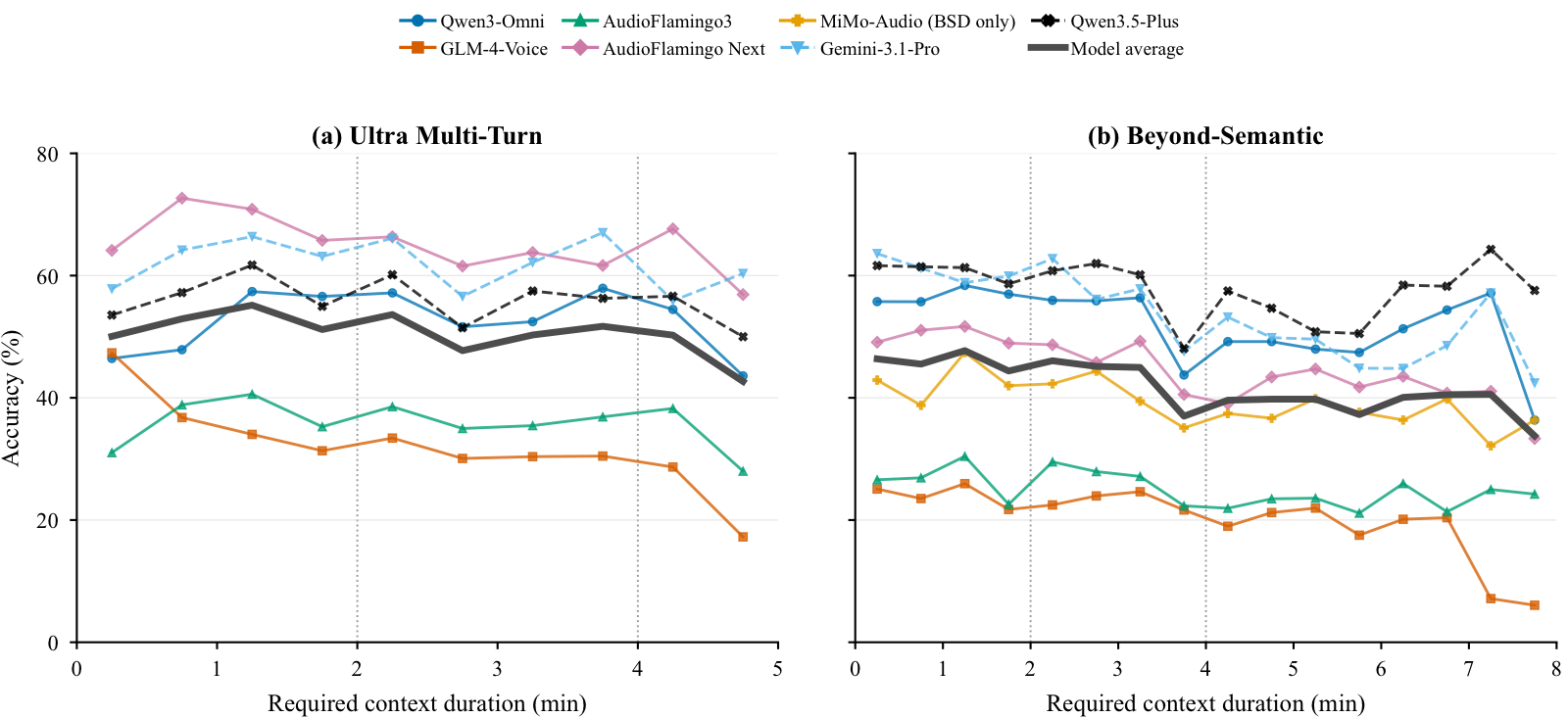
Long-context understanding remains a fundamental challenge for large language models, as excessively long inputs often lead models to forget salient information. This issue is even more pronounced in the speech domain, where audio, as a low-compression modality, requires substantially more embeddings than text to preserve both semantic content and acoustic cues. To address this challenge, we introduce Vox-Infinity, the first benchmark specifically designed to evaluate long-context understanding in spoken language models. Vox-Infinity systematically extends audio history along two dimensions: turn count and turn duration. It covers a diverse range of representative scenarios with varying interaction structures and semantic complexity. Crucially, Vox-Infinity provides explicit answer-provenance annotations and organizes samples according to the amount of historical context required to resolve each query, enabling precise and length-aware evaluation. Extensive evaluations of seven representative spoken language models reveal a clear overall recency effect: models generally achieve higher accuracy when answer-supporting evidence is closer to the query, but struggle to retrieve and use evidence located farther back in the dialogue history.
Vox-Infinity scales dialogue history along turn count and turn duration across three complementary scenarios, each targeting a distinct long-context capability.

Conversations with 20+ turns (from SpokenWOZ). Frequent back-and-forth exchanges that require retrieving exact slot values, e.g. phone numbers and train IDs, from dense histories.
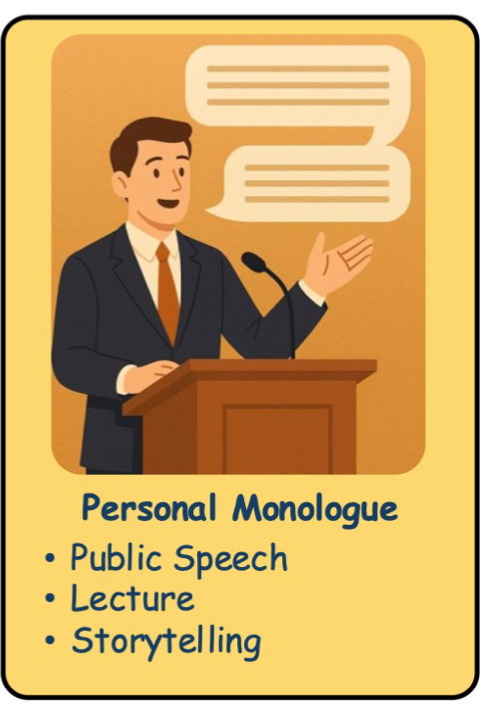
Single-speaker speeches longer than two minutes (from GigaSpeech). Questions require multi-hop reasoning over evidence distributed throughout long-form speech.
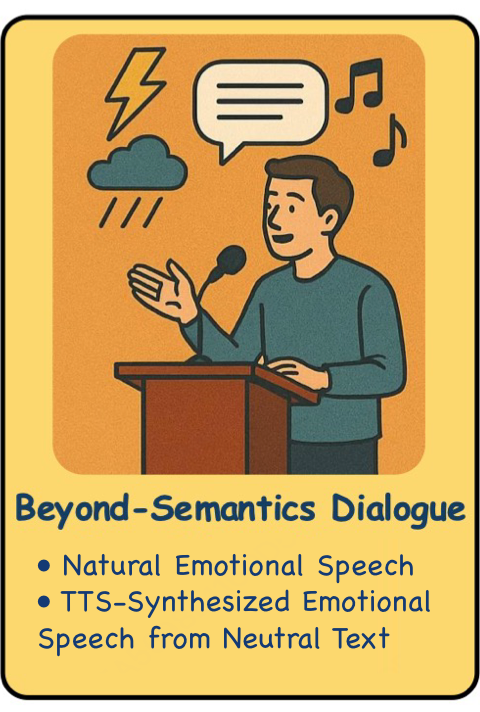
Extended conversations (from IEMOCAP + emotion-controlled TTS) that require retaining and retrieving emotions conveyed through vocal expression, not text alone.
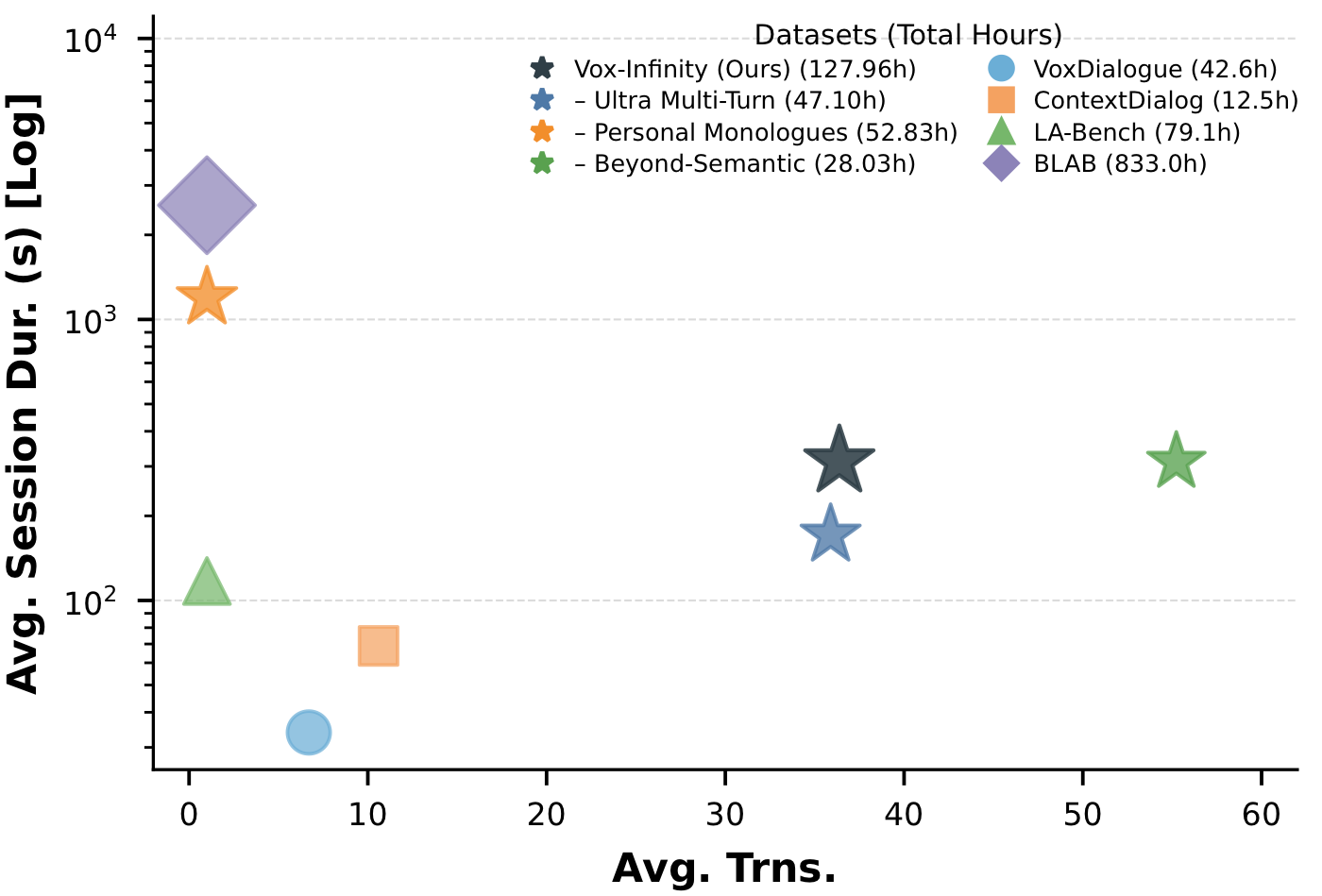
| Benchmark | Sessions | QAs | Dur. (h) | Avg. Dur. (s) | Avg. Trns. | Provenance |
|---|---|---|---|---|---|---|
| VoxDialogue | 4,526 | 4,526 | 42.56 | 33.9 | 6.70 | ✗ |
| ContextDialog | 653 | 2,612 | 12.50 | 68.9 | 10.60 | ✗ |
| LA-Bench | 2,429 | 2,429 | 79.12 | 117.3 | 1.00 | ✗ |
| BLAB | 1,176 | 1,600 | 833.0 | 2,550.0 | 1.00 | ✗ |
| Vox-Infinity (ours) | 1,474 | 13,516 | 127.96 | 312.5 | 36.38 | ✓ |
| — Ultra Multi-Turn | 991 | 7,086 | 47.10 | 171.1 | 35.89 | ✓ |
| — Personal Monologues | 159 | 1,050 | 52.83 | 1,196.1 | 1.00 | ✓ |
| — Beyond-Semantic | 324 | 5,380 | 28.03 | 311.4 | 55.23 | ✓ |
Table 1. Comparison with existing long-context audio benchmarks. Vox-Infinity is the first to provide explicit answer-provenance annotations and multiple required-context-duration bins (0–2, 2–4, 4–8, 8+ min).
We benchmark seven spoken language models — Qwen3-Omni, GLM-4-Voice, AudioFlamingo3, AudioFlamingo Next, MiMo-Audio, Gemini-3.1-Pro and Qwen3.5-Plus — with dialogue history given as either text or audio.
| Model | Ultra Multi-Turn | Personal Monologues | Beyond-Semantic | |||
|---|---|---|---|---|---|---|
| Text | Audio | Text | Audio | Text | Audio | |
| Qwen3-Omni | 84.8 | 55.0 | 85.5 | 70.5 | 46.2 | 53.2 |
| GLM-4-Voice | 59.4 | 34.8 | 27.6 | 13.2 | 41.0 | 22.3 |
| AudioFlamingo3 | 43.4 | 34.4 | 49.0 | 44.0 | 18.5 | 25.5 |
| AudioFlamingo Next | 74.9 | 32.2 | 62.2 | 45.4 | 41.2 | 46.7 |
| MiMo-Audio | 76.6 | 22.5 | 67.7 | 12.5 | 30.0 | 40.3 |
| Gemini-3.1-Pro† | 79.0 | 62.8 | 82.6 | 60.1 | 53.2 | 57.5 |
| Qwen3.5-Plus† | 81.1 | 56.8 | 84.4 | 64.6 | 52.9 | 58.1 |
Table 2. Average accuracy (%) per subset under text vs. audio history. Higher of the two is highlighted; † marks closed-source models.
Accuracy declines as supporting evidence moves farther from the query. On Ultra Multi-Turn (audio), the model average falls 43.4%→38.2% from 0–2 to 4–8 min; on Beyond-Semantic it drops 46.3%→39.7%→23.7% beyond eight minutes.
Compact transcripts better retain precise lexical evidence. On Ultra Multi-Turn, text history beats audio for every model (mean 71.3% vs. 42.6%), where questions need exact slot values.
Transcripts discard intonation and intensity. On Beyond-Semantic, audio history outperforms text for six of seven models, preserving paralinguistic emotion cues unavailable in text.
@inproceedings{voxinfinity2027,
title = {Vox-Infinity: Benchmarking the Limits of Long-Context
Spoken Language Models},
author = {Anonymous},
booktitle = {Under review},
year = {2027},
url = {https://vox-infinity.github.io}
}
Cases and datasets are available at https://vox-infinity.github.io.